ServicesWater Filtration
Whole Home Water Filtration in Woodbury, TN
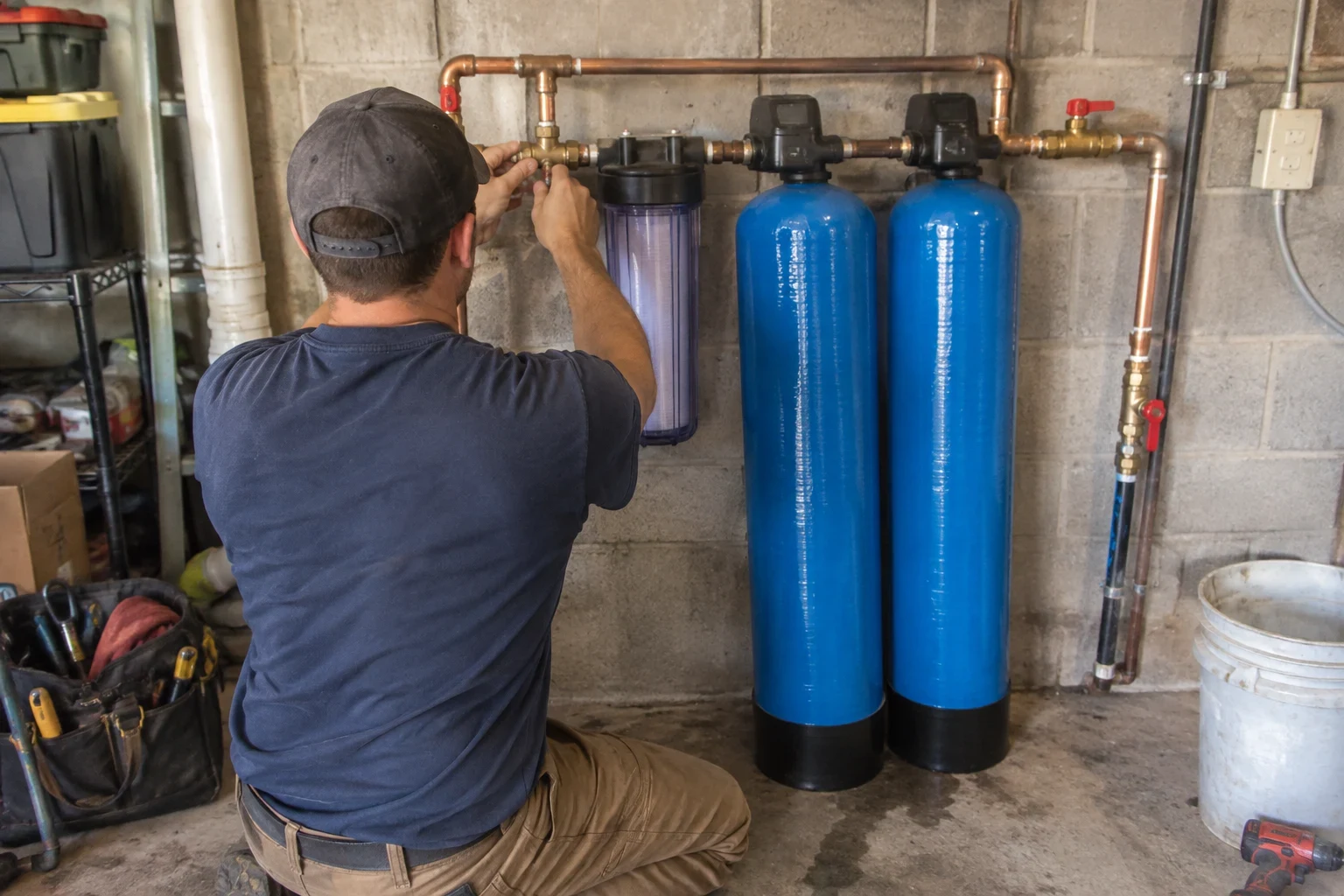
We test your water first, then size a whole-house system to your home's flow rate and plumbing. Install day runs on a plan. You know when we arrive, how long the water will be off and where each housing will mount before we cut into a single pipe.
What a whole-house system does and when it makes sense
A whole home water filtration system mounts at the point of entry, just past your main shutoff and before the water heater. Because it treats water before the lines branch off, the shower, washing machine, ice maker and every faucet draw from the same clean supply. Chlorine, sediment and hardness minerals do damage well beyond flavor. Scale builds up on heating elements and on the heat exchanger inside a tankless unit. Grit wears down faucet cartridges and toilet fill valves. Chlorine in a hot shower dries out skin and hair just as surely as it flavors a glass of drinking water.
Which stages you need depends on what your water carries. Municipal water usually calls for sediment and carbon stages aimed at chlorine or chloramine. Much of Middle Tennessee draws from limestone-fed sources, so hard water is common. A private well can add iron or bacteria to the list. We test before we recommend anything, so the system you pay for targets the problem you have and skips equipment you do not need.
What the work includes
On-site water test
We check hardness, chlorine, iron, pH and total dissolved solids at your tap. The numbers decide the equipment, and we walk you through what each one means.
Sizing to your flow rate
We count fixtures and bathrooms to estimate peak gallons per minute, then match tank and cartridge sizes to it. An undersized filter is the most common reason a new system leaves the shower weak.
Sediment prefilter
A spin-down or cartridge prefilter catches sand and scale flakes before they reach the carbon or softener media. This protects the expensive stages and makes them last longer.
Carbon or catalytic carbon stage
Standard activated carbon removes chlorine, taste and odor. If your supplier uses chloramine, we use catalytic carbon, which breaks that compound down far more effectively.
Bypass loop and isolation valves
Every system gets a three-valve bypass. You can change filters or service the unit without shutting off water to the whole house.
Drain, power and cleanup
Backwashing tanks and softeners need a drain connection with an air gap and, often, an outlet. We set both up properly, sweep the work area and haul away packaging.
Signs your home could use whole-house filtration
White crust on fixtures and glass
Chalky buildup on showerheads, faucets and dishes is calcium and magnesium carbonate. It points to hard water, and the same scale is forming inside your water heater.
Chlorine smell in the shower
If hot water carries a pool smell, chlorine or chloramine is vaporizing as you bathe. A carbon stage at the point of entry removes it before it reaches any fixture.
Orange or brown stains
Rust-colored rings in toilets and tubs usually mean dissolved iron, more common on well water. Iron also fouls softener resin unless it is treated first.
Grit in aerators and fill valves
Sand in faucet screens or a toilet that keeps running because of debris in the fill valve means sediment is moving through your lines.
Water heater working harder
Popping or rumbling from a tank heater, or scale error codes on a tankless unit, often trace back to minerals. Treating the water protects the heater you already paid for.
How install day runs
- 1
Test and written estimate
We test your water, look at your main line size and where it enters, and pick a mounting spot. You get a free written estimate listing each stage and why it is there.
- 2
An arrival window you can plan around
We book a window that fits your day and call ahead before we head over. If an earlier job runs long, we tell you right away and give you a revised time.
- 3
Water off, system in
Most installs take a few hours, with the water off for part of that. We tell you the expected shutoff time before we close the main so you can fill a pot or finish a load of laundry first.
- 4
Startup and walkthrough
We flush the carbon media, program any control valve and check for drips at every fitting under pressure. Then we show you the bypass, the filter change schedule and what each gauge should read.
What moves the price
Whole-house filtration has no flat price, because no two water tests come back the same. The cost follows how many treatment stages your water needs, how large the equipment must be to keep up with your home, and how much pipe work it takes to tie into the main line. Your free estimate breaks out each component on its own line, so nothing hides inside a single total. If you would rather spread the cost out, ask about our financing options; cash and any major credit card work for payment too.
- What your water test shows
- Chlorine alone may only call for a single carbon tank. Hard water carrying iron with chlorine on top can take three stages plumbed in series, each with its own media and housing.
- Home size and peak flow
- Every added bathroom raises peak demand. Keeping pressure steady at that demand takes bigger tanks or higher-capacity cartridges.
- Where your main line enters
- A main that rises in an open garage or utility room is a quick tie-in. One that comes through a tight crawlspace or behind a finished wall takes more labor and more fittings.
- Drain and electrical access
- Backwashing equipment needs a drain and often an outlet nearby. When neither sits close to the mounting spot, we extend them, and that adds to the job.
Water filtration questions
Something not covered here? (931) 236-1835
Is a water softener the same as a whole-house filter?
No, they do different jobs. A softener passes water through resin beads that trade the hardness minerals, calcium and magnesium, for sodium or potassium ions, and that exchange is what keeps scale from forming. A filter relies on media such as activated carbon to pull out chlorine, odors and certain chemicals. Plenty of homes benefit from both, with the filter plumbed upstream of the softener.
Will filtration lower my water pressure?
Each stage adds some resistance, but a properly sized system keeps the drop small enough that you should not feel it at the showerhead. Noticeable pressure loss usually comes from housings that are too small or cartridges that are overdue for a change. We size from your peak flow and show you which gauge reading means it is time for a new cartridge.
How often do filters need changing?
Sediment cartridges usually last a few months, depending on how much debris your water carries. Carbon tanks hold up much longer, often several years. We set a change schedule from your test results and how much water your household uses.
Does this work on well water?
Yes, though a well often needs different stages than city water. Iron, a sulfur smell and bacteria are the usual concerns, and a UV lamp may be part of the setup. Your water test shows which of those apply.
How long will I be without water?
On most installs the water is off for a few hours, not all day. We give you the shutoff time ahead of the visit and turn the water back on once every fitting is tightened and tested under pressure.
Find out what is in your water
We test it, explain the numbers and price the system that fixes your problem, with a clear arrival window for install day. Our phone is also answered 24/7 if a plumbing emergency comes up.